








From Shirdi to the World: Aushim K. Khetrapal’s Sai Satcharitra – The New Testament Chronicles Modern-Day Miracles
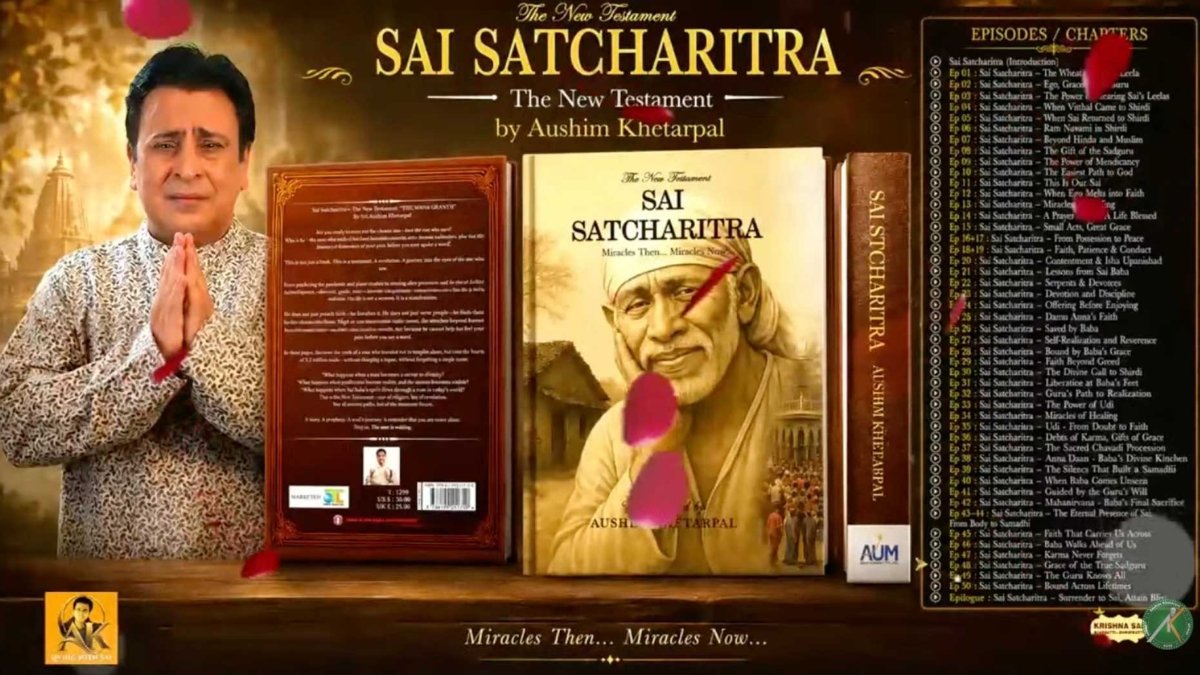
Mumbai (Maharashtra) [India], September 5: What if the miracles recorded more than a century ago were not the end of the story? What if Sai Baba’s devotees continue to experience moments of faith, answered prayers, unexpected guidance and what they believe to be divine intervention even today? This thought forms the foundation of filmmaker, actor, producer, spiritual author and Sai devotee Aushim K. Khetrapal’s ambitious new spiritual granth, Sai Satcharitra – The New Testament: Miracles Then and Miracles Now.
“Hemadpant Wrote What Happened Then. I Am Recording What Devotees Believe Is Happening Now,” Says Aushim K. Khetrapal
Inspired by Hemadpant’s revered Shri Sai Satcharitra, Khetrapal’s new work attempts to document the experiences of a contemporary generation of Sai devotees. The book comprises 52 Adhyayas and has been conceived as a companion to Hemadpant’s classic rather than a replacement for it. While Hemadpant recorded the life, teachings, leelas and experiences associated with Sai Baba during his lifetime, Khetrapal turns his attention towards the experiences devotees say they continue to have in the present day. The central thought behind the book is summed up in its powerful line, “Miracles Then. Miracles Now.”
For Khetrapal, the book is the culmination of nearly two decades of interaction with Sai devotees and people seeking guidance. According to the author, over approximately 18 years, he has responded to more than 5.1 million questions and requests for guidance. Behind these numbers, he believes, are countless personal stories of people dealing with fear, uncertainty, loss, hope and difficult circumstances, many of whom believe they found strength, direction or an unexpected answer through their faith in Sai Baba.
“Hemadpant wrote what happened then. This book records what devotees believe is happening now. Sai Baba’s miracles did not end with time. They continue to manifest through faith, service, guidance and the lives of ordinary people. This granth is our humble attempt to preserve those experiences for generations to come,” says Khetrapal.
The fundamental philosophy of the book remains rooted in the principles traditionally associated with Sai Baba — Shraddha and Saburi, or faith and patience, along with compassion, equality, service and the belief that spirituality can transcend religious and social boundaries. Rather than presenting spirituality only through historical accounts, Khetrapal seeks to bring the conversation into the lives of contemporary people and document how Sai Baba continues to be experienced by devotees in a rapidly changing world.
Interestingly, the journey of Sai Satcharitra – The New Testament has already extended beyond India. In June 2026, Khetrapal presented the book to Baba Mondi, the spiritual leader of the Bektashi World Order in Albania. The interaction brought together two distinct spiritual traditions and was associated with a larger message of peace, coexistence and interfaith harmony. For Khetrapal, the journey from Shirdi to Albania represents the universal nature of Sai Baba’s message and the possibility of spirituality becoming a bridge between cultures rather than a boundary separating them.
The book has also entered a wider conversation around interfaith dialogue and global peace, including engagement with the Catholic world and discussions surrounding the Vatican. At a time when conversations around religious harmony, fraternity and coexistence have become increasingly significant, Khetrapal believes that Sai Baba’s philosophy has a natural place in this larger dialogue. His emphasis is not merely on miracles, but on the values that devotees associate with those experiences — compassion, humanity, service and the ability to reach beyond religious identities.
The connection with Shirdi remains at the heart of the project. For millions of devotees who visit Shirdi, Sai Baba is not merely a historical figure from the nineteenth century. He continues to remain a living presence in their spiritual lives. The Shree Saibaba Sansthan Trust, Shirdi, under the leadership of CEO Shri Goraksha Gadilkar, IAS, continues to serve devotees through temple administration, charitable initiatives, healthcare, education and technology-driven services. The Sansthan’s increasing use of digital platforms to make information and Sai-related services accessible to devotees across the world also reflects the changing ways in which people engage with an ancient spiritual tradition.
In many ways, this evolution mirrors the intention behind Khetrapal’s book. The faith may be centuries old, but the devotee of today lives in a completely different world. The stories being documented are therefore not only about what happened in Shirdi in the past, but about what people believe they experience after they leave Shirdi and return to their everyday lives.
The project has already reached a substantial audience, with more than 40,000 copies reportedly distributed across the world. The work is also moving beyond the printed format, with audio editions being developed to make the content accessible to a wider audience. Editions are being developed in multiple Indian languages, including Hindi, English, Marathi and Telugu, with the larger vision extending to approximately 12 languages.
What makes Sai Satcharitra – The New Testament distinctive is its focus on personal experiences. The book brings together stories of devotees who believe that an impossible situation changed, families who feel they received help during a crisis, individuals who found courage at a difficult point in their lives and seekers who say their faith gave them a new direction. These accounts are presented as personal testimonies and spiritual experiences rather than scientific proof. For those who experienced them, however, the emotional and spiritual significance remains deeply personal.
The title The New Testament is itself intended to convey the idea of continuity. Hemadpant’s Sai Satcharitra documented the experiences surrounding Sai Baba more than a century ago. Khetrapal’s work looks at the present and asks what devotees are experiencing today. In that sense, the book attempts to create a bridge between two generations — connecting the Sai Baba remembered through historical accounts with the Sai Baba experienced through the faith of contemporary devotees.
Khetrapal’s own journey across cinema, television, production, spiritual writing and Sai-related projects adds another dimension to the initiative. His attempt is to bring spiritual storytelling into a format that can connect with today’s audience while retaining the essence of Sai Baba’s teachings. The result is intended to be more than a traditional religious publication; it is an attempt to preserve a collection of contemporary human experiences shaped by faith.
At its core, the book is ultimately about people — their struggles, their prayers, their hopes and their belief. It speaks of faith without fear, service without expectation, compassion without boundaries and humanity without labels. From Shirdi to international spiritual circles, from printed pages to digital audio and from Hemadpant’s generation to today’s devotees, the journey of Sai Satcharitra continues to evolve.
More than a century ago, Hemadpant recorded stories that became part of the spiritual memory of millions. Today, Khetrapal believes another generation has its own stories to tell. Sai Satcharitra – The New Testament seeks to preserve those experiences so that the present does not disappear into memory.
The question at the heart of the book is therefore both simple and profound: if miracles were recorded then, can they still be happening now?
For the devotees whose experiences form the foundation of this new granth, the answer is a matter of faith.
Miracles Then. Miracles Now. And perhaps, Miracles Forever.
About Aushim K. Khetrapal: Aushim K. Khetrapal is an Indian filmmaker, actor, producer and spiritual author whose creative and spiritual work has explored themes of faith, humanity, peace and interfaith harmony. His association with Sai Baba-related cinema and spiritual storytelling includes the film Shirdi Sai Baba as well as books and audio-visual projects centred on Sai philosophy and devotees’ experiences.